
Contents:
- What Are Corporate Away Days and Team Events
- Why the Countryside Is Ideal for Corporate Events
- Key Benefits for Teams and Organisations
- Best Venue Types for Corporate Away Days
- Activities and Event Formats
- Accommodation and Residential Options
- Planning, Logistics, and Scheduling
- Budgets and Cost Planning
- Future Trends in Corporate Away Days
What Are Corporate Away Days and Team Events
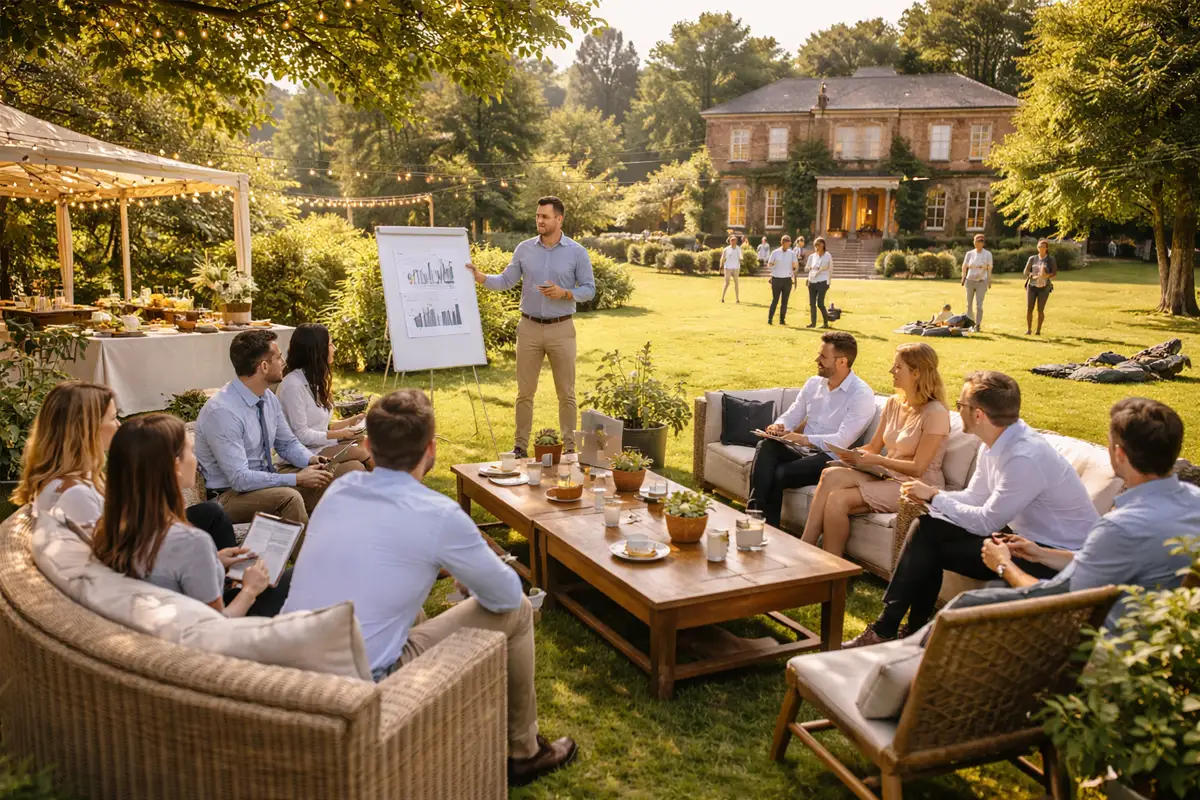
Corporate away days and team events are structured offsite gatherings designed to strengthen teamwork, improve communication, and support organisational development outside the regular workplace environment. These events range from strategic leadership retreats and training workshops to informal team-building experiences and company celebrations.
Typical objectives of corporate away days
- Strengthening collaboration and interpersonal relationships
- Improving communication and team alignment
- Supporting leadership development and strategic planning
- Rewarding performance and boosting employee morale
Unlike standard meetings or conferences, away days remove teams from daily routines and distractions. This change of environment encourages creativity, openness, and more authentic interaction between colleagues.
Formats vary widely depending on organisational goals. Some programmes focus on facilitated workshops and training, while others prioritise experiential activities, informal networking, and social connection.
Modern corporate events increasingly blend structured content with relaxed hospitality, creating balanced programmes that support both performance and wellbeing.
Why the Countryside Is Ideal for Corporate Events
The countryside offers a uniquely effective setting for corporate away days. Rural venues provide physical separation from the workplace, allowing teams to reset mentally, disengage from operational pressures, and focus fully on collaboration and development.
Advantages of countryside locations
- Peaceful environments that reduce stress and distraction
- Exclusive-use venues offering privacy and confidentiality
- Access to outdoor spaces for activities and informal sessions
- Stronger sense of retreat and renewal
Country house estates, rural conference centres, and boutique retreat venues create a natural transition from formal working modes to reflective and creative thinking. Fresh air, landscaped grounds, and historic architecture contribute positively to mood and engagement.
Privacy is a major advantage. Away from urban venues and shared conference centres, organisations can conduct sensitive discussions, leadership planning, and strategic sessions without interruption or confidentiality risk.
The countryside also enables integrated programmes combining meetings, outdoor activities, dining, and overnight accommodation within a single cohesive location.
Key Benefits for Teams and Organisations
Well-designed corporate away days deliver measurable benefits across performance, engagement, and organisational culture. When teams step outside daily routines, they often reconnect with purpose, values, and collective goals more effectively.
Organisational benefits of away days
- Improved communication and conflict resolution
- Stronger trust and interpersonal relationships
- Enhanced creativity and problem-solving capacity
- Higher employee engagement and retention
Teams frequently report increased openness and psychological safety during offsite events. Hierarchies soften, informal interaction increases, and collaboration becomes more natural and productive.
Leadership teams benefit particularly from rural away days, where strategic discussions can unfold without constant interruptions, allowing deeper focus on long-term planning and organisational direction.
Beyond immediate outcomes, these events strengthen organisational culture by building shared experiences that reinforce identity, loyalty, and collaboration long after the programme concludes.
Best Venue Types for Corporate Away Days
Venue selection is one of the most important strategic decisions when planning a corporate away day. The right setting supports productivity, comfort, confidentiality, and engagement while reinforcing the intended tone of the event.
Popular countryside venue types for corporate events
- Country house hotels with conference and breakout facilities
- Exclusive-use estates offering privacy and flexible layouts
- Boutique retreat centres designed for leadership development
- Rural conference venues with integrated outdoor activity space
Country house venues are particularly effective for senior leadership retreats and strategic planning sessions, combining formal meeting rooms with elegant dining and accommodation.
Exclusive-use estates allow organisations to control the entire environment, including branding, scheduling, and security. This is especially valuable for board meetings, mergers, executive training, and confidential discussions.
When evaluating venues, organisations should consider accessibility, capacity, technical infrastructure, accommodation availability, and the flexibility to adapt spaces to different programme phases.
Activities and Event Formats
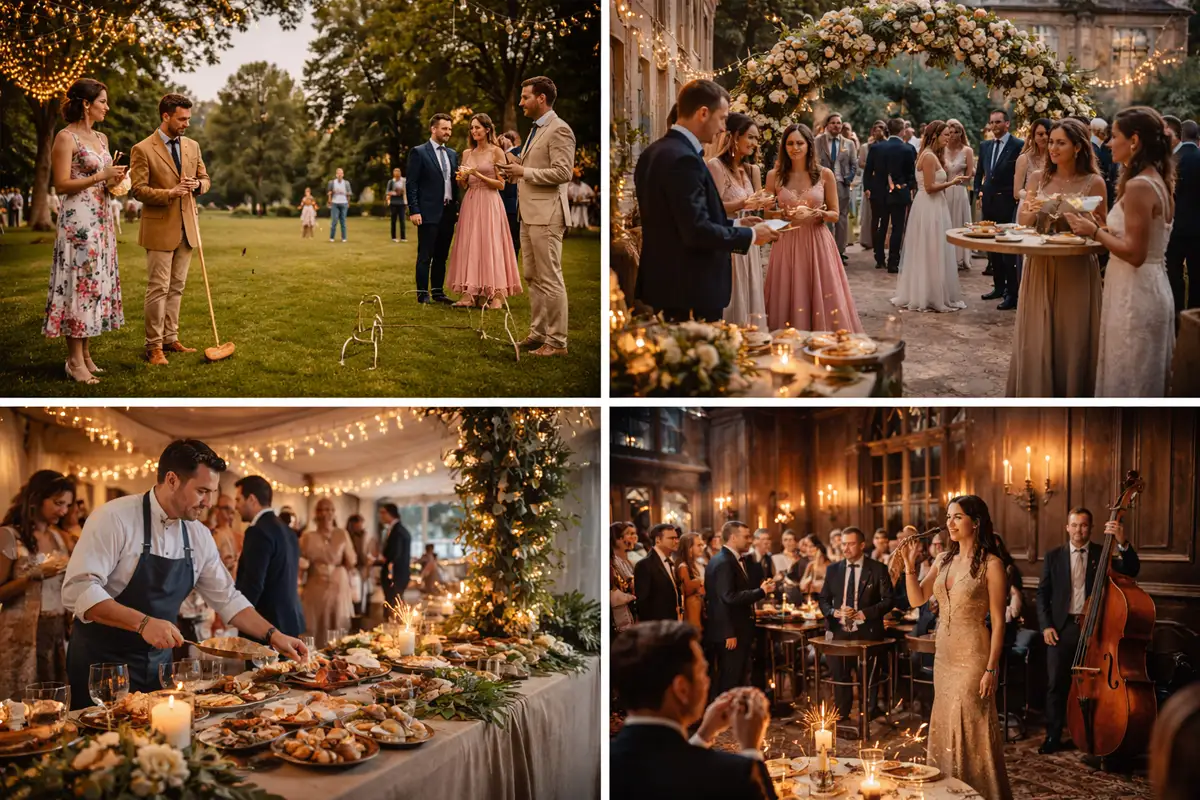
Programme design determines whether an away day becomes a meaningful development experience or simply an offsite meeting. Effective formats combine structured business sessions with interactive activities and informal social time.
Common corporate away day formats
- Leadership retreats and strategic planning sessions
- Team-building programmes and experiential workshops
- Training and professional development events
- Company celebrations, rewards, and recognition events
Outdoor activities are a major advantage of countryside locations. Problem-solving challenges, guided walks, archery, raft building, and orienteering encourage collaboration and communication in relaxed, non-hierarchical settings.
Facilitated workshops, coaching sessions, and breakout groups provide structure and ensure learning objectives are met. These sessions often alternate with experiential activities to maintain energy and engagement.
Evening formats may include hosted dinners, informal networking, fireside discussions, or entertainment to strengthen relationships and encourage cross-team interaction.
Accommodation and Residential Options
Residential programmes significantly enhance the effectiveness of corporate away days. Overnight stays allow deeper engagement, extended networking, and multi-day development formats without travel disruption.
Key accommodation considerations
- Room quality and comfort standards
- Single occupancy versus shared accommodation policies
- Proximity between meeting rooms and bedrooms
- Availability of informal breakout and relaxation spaces
Country house hotels and estates often offer a limited number of high-quality rooms, which suits executive retreats and senior management groups particularly well.
Residential settings encourage informal evening interaction, shared dining experiences, and reflective discussion outside formal sessions. These moments often generate the most valuable insights and relationship building.
For larger groups, hybrid models combining on-site rooms with nearby accommodation can provide flexibility while maintaining programme continuity.
Planning, Logistics, and Scheduling
Operational planning is the foundation of successful corporate away days. Rural venues introduce additional logistical considerations, including transport coordination, access routes, technical setup, and supplier sequencing.
Key logistical planning priorities
- Transport arrangements and arrival scheduling
- Technical setup for presentations and hybrid sessions
- Room allocation and breakout sequencing
- Catering timing aligned with programme flow
Detailed agendas should balance formal sessions with breaks, outdoor activities, and informal networking. Overloaded schedules reduce engagement and learning effectiveness.
Access times for suppliers, AV technicians, and facilitators must be carefully coordinated, particularly when venues host only one corporate group at a time.
Clear communication with participants before arrival ensures expectations, dress codes, transport details, and programme objectives are fully understood.
Budgets and Cost Planning
Corporate away day budgets vary widely depending on group size, duration, venue type, accommodation level, and programme complexity. Transparent budgeting ensures strong return on investment and prevents late-stage cost escalation.
Main budget components
- Venue hire and meeting room packages
- Accommodation and residential services
- Catering, refreshments, and hosted dinners
- Facilitators, trainers, and activity providers
- AV, staging, and technical infrastructure
One-day non-residential events typically offer the most cost efficiency, while multi-day residential programmes deliver higher development impact but require larger investment.
Many countryside venues provide inclusive corporate packages that bundle meeting rooms, meals, and accommodation, simplifying cost management.
Budget planning should always include contingency allowances for weather disruption, extended sessions, and technical upgrades.
Future Trends in Corporate Away Days
Corporate away days are evolving in response to changing workplace cultures, hybrid working models, and increased focus on wellbeing and leadership development.
Emerging trends in corporate offsite events
- Hybrid retreats combining in-person and virtual participation
- Wellbeing-focused programmes with mindfulness and resilience training
- Shorter, high-impact micro retreats for leadership teams
- Sustainability-led venue selection and eco-friendly programming
Organisations increasingly prioritise experiences that support mental health, work-life balance, and long-term performance rather than purely recreational team-building.
Rural venues are adapting by offering wellness facilities, outdoor coaching spaces, digital infrastructure, and flexible residential packages designed for modern corporate needs.
This evolution positions countryside venues as central hubs for leadership development and organisational transformation.
Conclusion
Corporate away days and team events in the countryside offer a powerful platform for strengthening teams, developing leaders, and aligning organisations around shared goals. Rural settings provide the privacy, focus, and atmosphere needed to achieve deeper engagement and lasting outcomes.
When supported by the right venue, structured programming, and disciplined planning, away days become strategic investments rather than discretionary activities.
For organisations seeking performance improvement, cultural alignment, and meaningful team development, countryside corporate events represent one of the most effective and versatile tools in modern leadership practice.