
Contents:
- Is a Wedding Venue Business Viable in the UK?
- Choose the Right Wedding Venue Business Model
- Define Your Market and Venue Position
- Assess the Property Before Investing
- Planning, Legal, and Licensing Requirements
- Build a Financial Model and Calculate Break-Even
- Create Wedding Packages and Pricing
- Build a Reliable Supplier Network
- Design the Operation and Guest Experience
- Market the Venue and Generate Bookings
- Attract International Couples
- Develop Additional Revenue Streams
- A Practical 12-Month Launch Plan
- Wedding Venue Performance Metrics
- Common Wedding Venue Business Mistakes
Is a Wedding Venue Business Viable in the UK?
A wedding venue can become a valuable hospitality business, but owning an attractive property is not enough. The venue must combine a desirable setting with legal approval, reliable operations, disciplined pricing, effective marketing, and a guest experience that couples are willing to recommend.
The potential market is substantial. The Office for National Statistics recorded 246,897 marriages in England and Wales in 2022. This was 12.3% higher than in 2019, although part of the increase reflected weddings delayed during the pandemic.
This means there is consistent demand, but it does not mean every venue will succeed. Couples compare properties based on much more than appearance. Their decision may depend on:
- Location and accessibility
- Capacity and room layout
- Indoor and outdoor ceremony options
- Photography opportunities
- Accommodation nearby
- Food, drink, and entertainment options
- Clarity of packages and pricing
- Responsiveness during the enquiry process
- Reviews and recommendations
- The confidence created by the venue team
A successful venue therefore sells more than access to a building. It sells certainty, atmosphere, convenience, and the confidence that an important event will be managed professionally.
Choose the Right Wedding Venue Business Model
The first major decision is not the colour of the ballroom or the design of the garden. It is the business model. Different models create different levels of revenue, responsibility, investment, and risk.
1. Dry-hire venue
Under a dry-hire model, the couple rents the property and arranges most suppliers independently. The venue may provide tables, chairs, utilities, parking, and basic event supervision, but catering, decoration, entertainment, and coordination remain largely outside the package.
This model can reduce operational complexity, but the venue has less control over supplier quality and receives less revenue from each wedding.
2. Venue with preferred suppliers
The venue provides the property and maintains a vetted list of caterers, photographers, florists, entertainment providers, and coordinators. Couples retain choice while benefiting from suppliers who already understand the building, access arrangements, and event rules.
This model creates a balance between flexibility and operational control.
3. Managed wedding package
The venue combines hire, catering, drinks, furniture, staffing, coordination, and selected additions into one package. This provides a simpler buying experience for couples and increases average revenue per booking.
However, it requires stronger staffing, supplier contracts, food and drink systems, and cash-flow management.
4. Exclusive-use country house venue
An exclusive-use model gives the wedding party private access to the principal event spaces and grounds for an agreed period. Exclusivity can support premium pricing because it creates privacy, flexibility, and a stronger sense of occasion.
Historic properties and country houses are particularly well suited to this position, provided that access, maintenance, guest flow, and noise are carefully managed.
| Business model | Revenue potential | Operational complexity | Main risk |
|---|---|---|---|
| Dry hire | Lower to moderate | Lower | Inconsistent external suppliers |
| Preferred suppliers | Moderate | Moderate | Dependence on supplier quality |
| Managed package | Higher | High | Cost and staffing control |
| Exclusive use | Premium | High | High client expectations |
The correct model depends on the property, available capital, local demand, staffing capacity, and the level of control the owner wants over each event.
Define Your Market and Venue Position
A venue that tries to appeal to every couple usually communicates weakly to all of them. Define a recognisable position before investing heavily in decoration or advertising.
Possible wedding venue positions
- Historic country house weddings
- Small and intimate celebrations
- Luxury exclusive-use weddings
- Outdoor and garden ceremonies
- Weekend destination weddings
- Multicultural weddings
- Affordable weekday weddings
- Winter and Christmas weddings
- Dry-hire creative weddings
- Eco-conscious countryside celebrations
Your position should be supported by the physical property. A venue with formal architecture, landscaped grounds, and distinctive interiors may compete through heritage and atmosphere. A converted barn may compete through flexibility, scale, and a relaxed rural character.
Study the purchasing process from the couple’s perspective. Our guide to choosing a wedding venue explains the practical criteria people commonly compare, including capacity, access, weather alternatives, layout, and planning restrictions.
Create an ideal client profile
Define the type of couple most likely to value the venue:
- Where do they live?
- How far are they prepared to travel?
- How many guests are they inviting?
- What is their likely total wedding budget?
- Do they want full coordination or greater independence?
- Are they planning locally or from another country?
- Which venue characteristics matter most to them?
This information should guide packages, photography, website copy, advertising, open days, and supplier partnerships.
Assess the Property Before Investing
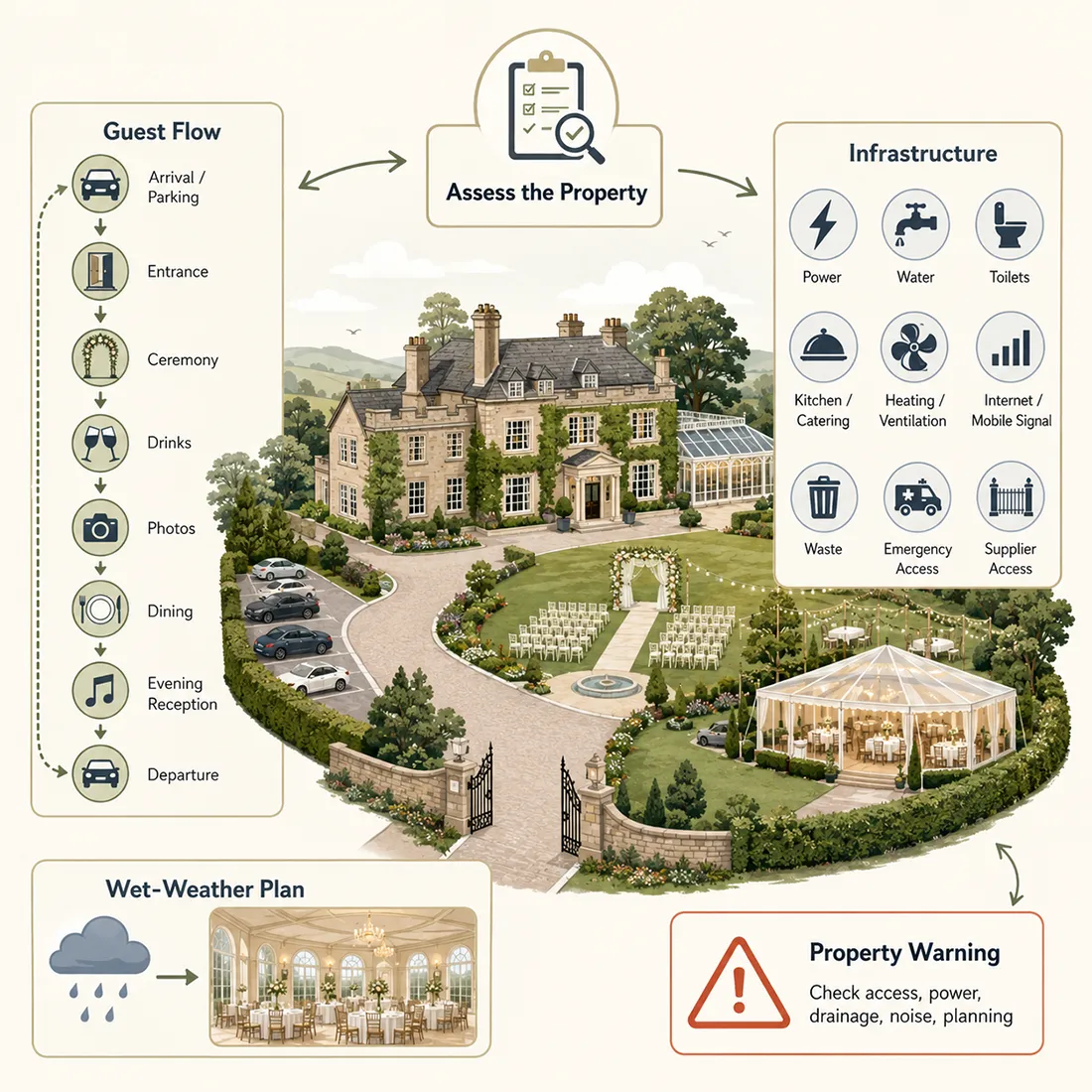
Before purchasing or converting a property, test whether it can function as an event venue in practice. Attractive photographs cannot compensate for insufficient parking, difficult access, inadequate utilities, poor sound control, or the absence of a reliable wet-weather plan.
Capacity and guest flow
Calculate comfortable capacity rather than maximum theoretical capacity. Guests, staff, furniture, dance floors, service stations, entertainment equipment, and emergency routes all require space.
Map the full guest journey:
- Arrival and parking
- Entrance and welcome
- Ceremony
- Drinks reception
- Photography
- Wedding breakfast
- Speeches and entertainment
- Evening reception
- Departure or transport
The transition between these stages should feel natural and should not require extensive resetting of the same room unless the operating plan allows sufficient time and staff.
Infrastructure assessment
- Electrical capacity for catering, lighting, entertainment, and heating
- Reliable water supply and drainage
- Sufficient guest toilets
- Commercial kitchen or catering preparation space
- Mobile signal and internet coverage
- Heating and ventilation
- Accessible entrances and facilities
- Supplier loading and service access
- Waste collection and storage
- Emergency access
Weather resilience
A UK wedding venue needs a complete indoor alternative for every weather-dependent part of the day. It is not enough to tell couples that a marquee or outdoor ceremony may work if there is no tested fallback arrangement.
Before launch, rehearse the entire event under wet-weather conditions. Confirm where photographs, the drinks reception, guest waiting, supplier deliveries, and room transitions will take place.
Planning, Legal, and Licensing Requirements
A wedding venue may require several different permissions. Approval to hold a civil ceremony does not automatically grant permission to operate an events business, sell alcohol, provide entertainment, prepare food, or alter a historic building.
Speak to the relevant local authority and qualified advisers before committing substantial capital.
Planning permission and change of use
Using a property regularly as a wedding venue may represent a material change of use. The planning authority can consider traffic, parking, noise, operating hours, lighting, temporary structures, landscape impact, and the effect on neighbouring properties.
Planning questions should be resolved before relying on projected wedding income. A property may be physically capable of hosting events but commercially restricted by operating conditions.
Civil marriage and civil partnership approval
In England and Wales, a venue must apply to its local council for a grant of approval before hosting civil marriages or civil partnerships.
The application identifies the specific indoor room or rooms in which ceremonies will take place. Outdoor areas within the grounds may also be approved when the relevant requirements are satisfied and suitable indoor rooms are identified.
The council must consider the premises suitable, dignified, safe, and regularly available for ceremonies. An approval is normally valid for a minimum of three years and must be renewed.
Alcohol and entertainment licensing
A premises licence may be required when the business sells alcohol or provides licensable entertainment. Depending on the operation, this may include live music, recorded music, dancing, performances, films, and late-night refreshments.
Where alcohol is sold under a premises licence, the business will generally need a designated premises supervisor who holds the appropriate personal licence.
Additional compliance areas
- Fire risk assessment and emergency procedures
- Public liability insurance
- Employer’s liability insurance when staff are employed
- Food registration and food hygiene systems for in-house catering
- Health and safety risk assessments
- Accessibility and reasonable adjustments
- Music licensing where applicable
- Waste and environmental health requirements
- Data protection for enquiries and customer records
- Business rates for non-domestic use
- Contracts, cancellation terms, and refund policies
Build a Financial Model and Calculate Break-Even
A wedding venue can appear profitable because couples pay large invoices, but total booking value is not the same as profit. Each event creates staffing, cleaning, utility, maintenance, supplier, administration, and marketing costs.
Separate fixed and variable costs
Fixed costs continue whether the venue hosts a wedding or not:
- Mortgage or rent
- Business rates
- Insurance
- Permanent salaries
- Security and monitoring
- Grounds and building maintenance
- Software and administration
- Professional fees
- Core marketing
Variable costs increase with each event:
- Casual event staff
- Cleaning and waste removal
- Laundry and consumables
- Utilities used during the event
- Security or parking personnel
- Supplier commissions
- Payment processing
- Food and beverage costs
- Damage and maintenance allowance
Calculate contribution per wedding
The contribution is the amount remaining after the variable costs of an event. It contributes towards annual fixed costs and then profit.
Contribution per wedding = Total wedding revenue − Variable event costs
Break-even weddings = Annual fixed costs ÷ Contribution per wedding
Illustrative wedding venue model
The following example is not a UK market average. It demonstrates how a venue owner can test the commercial model using local quotes and realistic operating costs.
| Item | Illustrative amount |
|---|---|
| Base venue hire | £8,500 |
| Furniture, coordination, and additions | £2,000 |
| Total revenue per wedding | £10,500 |
| Variable event costs | £3,000 |
| Contribution per wedding | £7,500 |
| Annual fixed costs | £225,000 |
| Break-even bookings | 30 weddings |
At 40 weddings with a contribution of £7,500 each, the venue would generate £300,000 towards fixed costs and operating profit. After £225,000 of fixed costs, the illustrative operating surplus would be £75,000 before finance costs, tax, depreciation, major capital expenditure, and owner drawings.
This calculation should also be tested under less favourable conditions:
- Lower booking volume
- Discounted winter pricing
- Higher staffing costs
- Unexpected repairs
- Cancellations or postponements
- Lower add-on sales
- Increased energy and insurance costs
Create Wedding Packages and Pricing
Pricing should reflect the value of the experience, the cost of operating the property, local competition, seasonal demand, and the capacity of the venue.
A confusing price list creates more administration and makes comparison difficult. Offer a small number of clear packages with transparent inclusions.
Example package structure
- Venue hire: ceremony and reception spaces, basic furniture, parking, and venue supervision
- Managed wedding: venue hire, furniture, coordination, setup, cleaning, and selected suppliers
- Exclusive-use celebration: private use of the principal spaces and grounds for an extended period
- Intimate wedding: a smaller package for lower guest numbers and selected dates
- Weekday wedding: a lower-demand date package with clearly controlled inclusions
Price by date and operational demand
Saturday dates in the main wedding season normally carry the strongest demand. Fridays, Sundays, weekdays, and winter dates may require a different commercial approach.
Discounts should not be automatic. A lower price may be combined with:
- Reduced access time
- Lower minimum guest numbers
- Fewer included spaces
- Limited setup options
- A simplified supplier package
Control additions and hidden costs
State clearly whether the price includes:
- VAT
- Tables and chairs
- Setup and breakdown
- Cleaning
- Security
- Corkage
- Heating
- Additional hours
- Registrar fees
- Damage deposits
Build a Reliable Supplier Network
A wedding venue is part of a larger service network. Caterers, florists, photographers, entertainers, coordinators, hire companies, transport providers, accommodation partners, and registrars all influence the couple’s experience.
Preferred supplier criteria
- Appropriate insurance
- Reliable communication
- Transparent pricing
- Experience at similar venues
- Professional setup and removal
- Compliance with venue rules
- Contingency arrangements
- Consistent client feedback
Do not select suppliers only because they offer the venue a commission. Recommendations create reputational responsibility. One poor supplier can damage the review of the entire wedding.
Create a supplier operating guide
The guide should explain:
- Access and loading times
- Parking arrangements
- Electrical limits
- Kitchen and preparation facilities
- Decoration restrictions
- Noise and finishing times
- Waste removal
- Emergency contacts
- Damage reporting
A formal supplier briefing reduces repeated questions and protects the building from avoidable damage.
Design the Operation and Guest Experience
Strong wedding operations are largely invisible to guests. Deliveries arrive without disrupting the ceremony, rooms are reset at the right time, staff know their responsibilities, and problems are solved before the couple becomes aware of them.
Detailed country house wedding planning is especially important in historic venues, where access routes, room capacities, protected interiors, and supplier movement may be more restricted than in purpose-built hotels.
Create an event operating plan
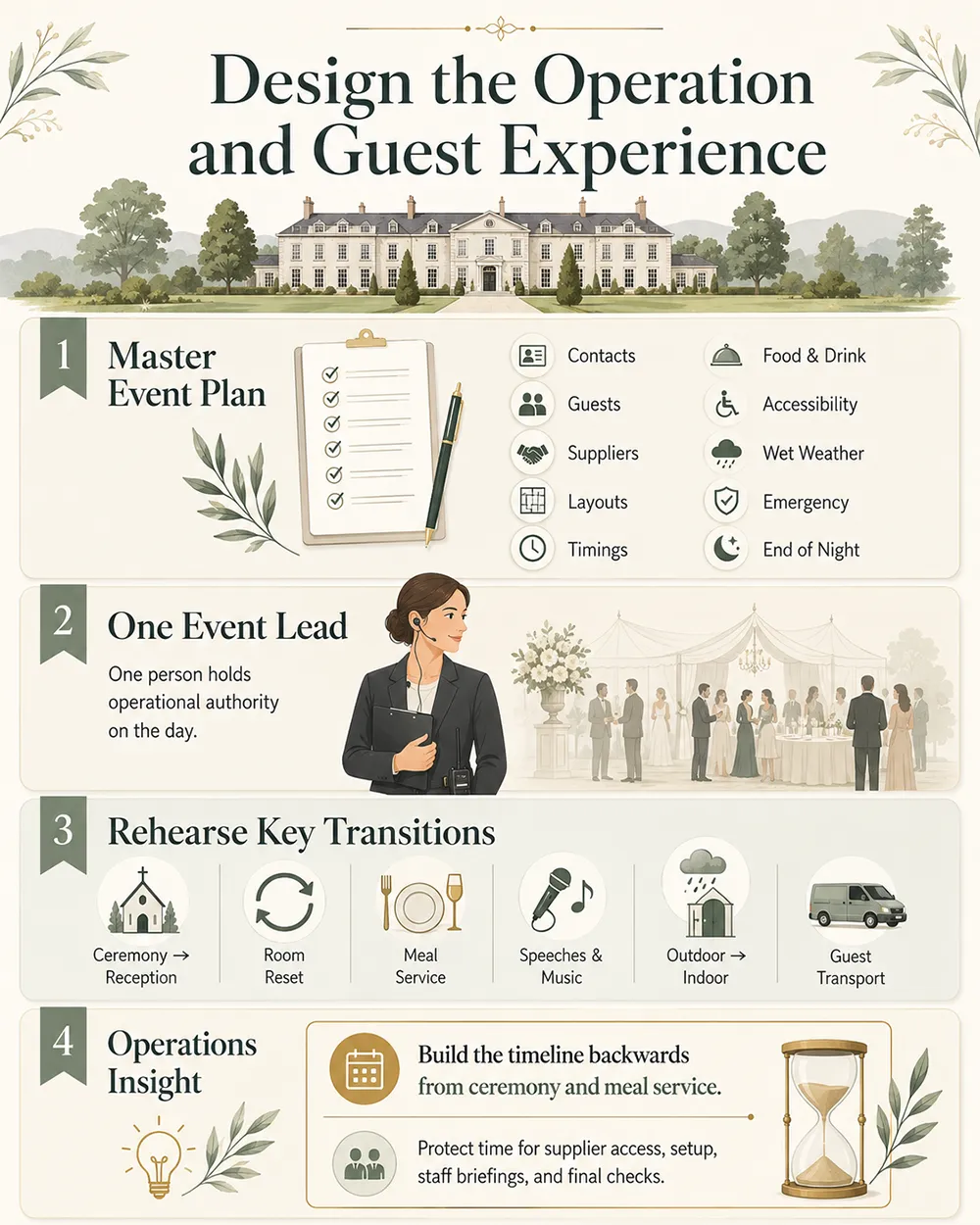
Each wedding should have one master document containing:
- Couple and emergency contacts
- Guest numbers
- Supplier list
- Access schedule
- Room layouts
- Ceremony and reception timings
- Food and drink arrangements
- Music and entertainment schedule
- Accessibility requirements
- Wet-weather alternative
- Emergency procedures
- End-of-night responsibilities
Assign clear responsibility
One person should hold operational authority during the event. Suppliers and team members need to know who can approve timing changes, resolve access problems, communicate with the couple, and activate contingency plans.
Rehearse difficult transitions
Test the operationally complex moments:
- Moving guests from ceremony to reception
- Resetting rooms
- Serving large numbers efficiently
- Managing speeches and entertainment
- Moving an outdoor ceremony indoors
- Coordinating transport at the end of the night
Market the Venue and Generate Bookings
Wedding venue marketing should lead couples through a clear sequence:
- Discover the venue
- Understand its style and capacity
- Check whether it fits their practical needs
- Request information
- Book a viewing
- Receive a proposal
- Pay a deposit and sign the contract
Build a website that answers real questions
The website should contain more than a gallery. Couples need practical information before they are ready to enquire.
Important pages include:
- Venue overview
- Ceremony spaces
- Reception spaces
- Capacity and layouts
- Packages and starting prices
- Food and drink options
- Accommodation and transport
- Frequently asked questions
- Real weddings
- Contact and viewing requests
Use several marketing channels
- Google Business Profile
- Organic search content
- Wedding directories
- Instagram and Pinterest
- Venue open days
- Photographer and planner referrals
- Email follow-up sequences
- Partnerships with nearby accommodation providers
- Features in regional wedding publications
Respond quickly and consistently
Couples often contact several venues within the same week. A response received after three or four days may arrive after another property has already arranged a viewing.
Create standard enquiry materials, but personalise the response using the couple’s date, expected guest count, ceremony preferences, and practical priorities.
Attract International Couples
Historic houses and distinctive countryside venues may attract couples living abroad, British couples based overseas, and families whose guests travel from several countries.
International enquiries create additional planning questions:
- How can the couple view the venue remotely?
- Which airports and railway stations are most convenient?
- Where can guests stay?
- Can deposits and balances be paid internationally?
- Which documents and registrar arrangements are required?
- Can planning meetings take place by video?
- Are suppliers comfortable communicating remotely?
- Which information is available in the couple’s language?
Create useful multilingual pages
A multilingual website should not be produced by placing unedited automatic translation over the English pages. The language version should explain the actual booking process, package terms, travel information, and practical requirements clearly.
Use separate, crawlable URLs for each language and maintain consistent navigation between equivalent pages. A detailed guide to planning the correct multilingual website structure explains how language folders, localisation, canonical tags, and hreflang should work together.
The most useful multilingual content for a wedding venue may include:
- Venue overview
- Packages and inclusions
- Travel guidance
- Accommodation information
- Booking and payment process
- Ceremony requirements
- Frequently asked questions
- International enquiry form
Start with languages supported by real demand rather than translating the entire website without a plan. Track enquiry quality, country, language, and conversion rate.
Develop Additional Revenue Streams
Wedding demand is seasonal and concentrated around particular days. A sustainable property should explore compatible uses that generate revenue without weakening its wedding identity.
Potential additional services
- Corporate meetings and away days
- Private celebrations
- Anniversary events
- Engagement parties
- Styled photography sessions
- Wedding fairs and open days
- Seasonal dining events
- Supplier workshops
- Film and photography location hire
Historic properties may be particularly suitable for business gatherings during weekdays and quieter wedding months. Our guide to corporate events at historic venues explains how heritage surroundings, privacy, flexible rooms, and outdoor areas can support professional events.
Additional revenue should fit the property and operating team. A long list of unrelated activities can create brand confusion, building damage, and staffing pressure.
Use the calendar strategically
- Reserve premium Saturdays for high-value weddings
- Use weekdays for corporate and smaller private events
- Create winter packages with controlled operating costs
- Schedule maintenance during known low-demand periods
- Protect setup time between major events
A Practical 12-Month Launch Plan
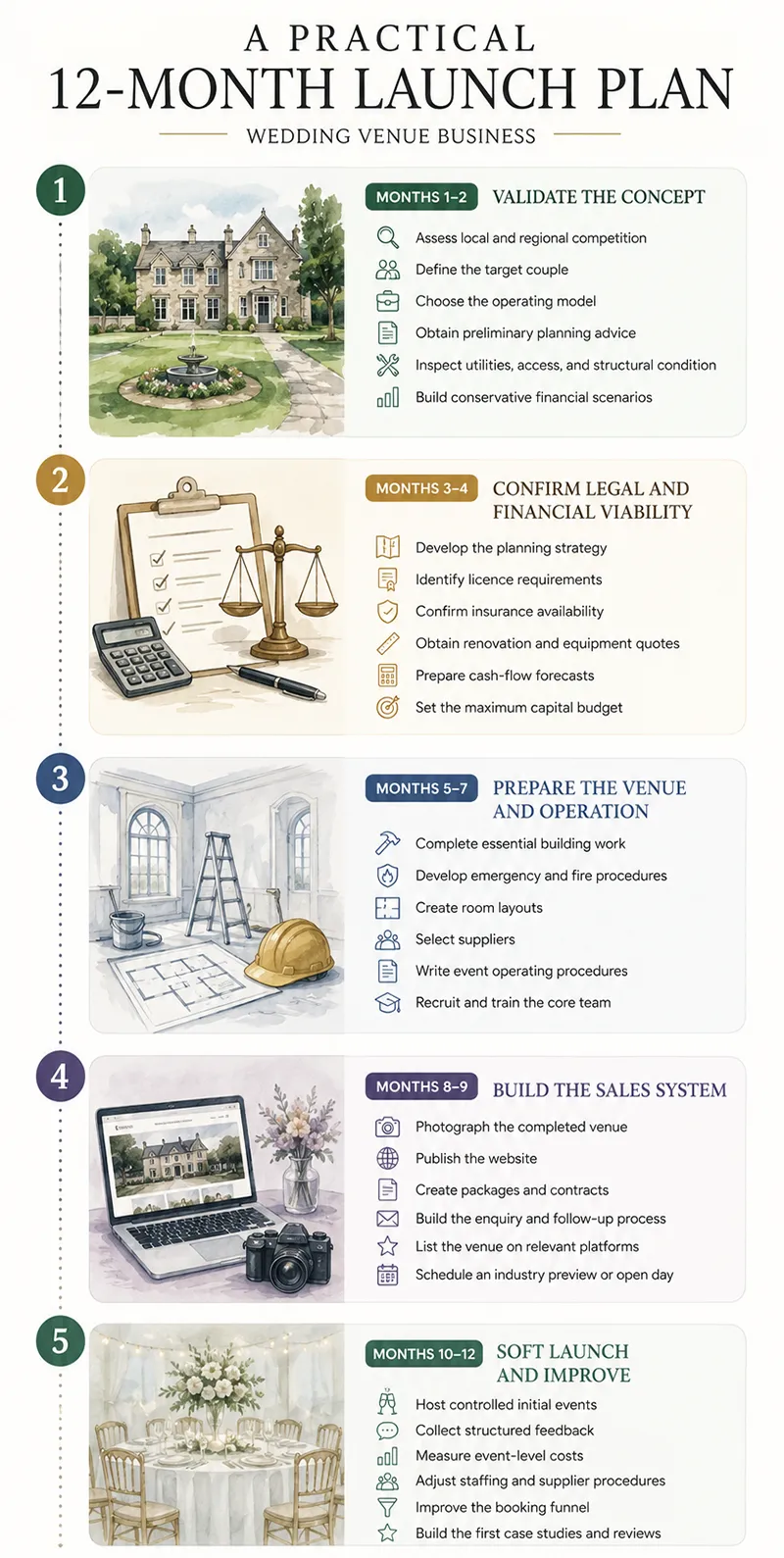
Months 1–2: Validate the concept
- Assess local and regional competition
- Define the target couple
- Choose the operating model
- Obtain preliminary planning advice
- Inspect utilities, access, and structural condition
- Build conservative financial scenarios
Months 3–4: Confirm legal and financial viability
- Develop the planning strategy
- Identify licence requirements
- Confirm insurance availability
- Obtain renovation and equipment quotes
- Prepare cash-flow forecasts
- Set the maximum capital budget
Months 5–7: Prepare the venue and operation
- Complete essential building work
- Develop emergency and fire procedures
- Create room layouts
- Select suppliers
- Write event operating procedures
- Recruit and train the core team
Months 8–9: Build the sales system
- Photograph the completed venue
- Publish the website
- Create packages and contracts
- Build the enquiry and follow-up process
- List the venue on relevant platforms
- Schedule an industry preview or open day
Months 10–12: Soft launch and improve
- Host controlled initial events
- Collect structured feedback
- Measure event-level costs
- Adjust staffing and supplier procedures
- Improve the booking funnel
- Build the first case studies and reviews
Wedding Venue Performance Metrics
Monitor the business monthly using operational and financial indicators.
| Metric | What it shows |
|---|---|
| Qualified enquiries | Demand from couples who match capacity, date, and budget |
| Enquiry-to-viewing rate | Effectiveness of the website and initial sales response |
| Viewing-to-booking rate | Strength of the venue experience, proposal, and pricing |
| Average revenue per wedding | Value of packages and additions sold |
| Contribution per wedding | Amount available to cover fixed costs and profit |
| Booking lead time | How far in advance revenue is secured |
| Date utilisation | Use of premium and lower-demand dates |
| Cancellation rate | Contract, communication, and market risk |
| Review and referral rate | Long-term customer satisfaction and reputation |
Analyse performance by month, event type, package, and acquisition channel. A venue may appear busy while accepting too many low-margin dates or spending heavily on enquiries that rarely convert.
Common Wedding Venue Business Mistakes
- Buying a beautiful property before checking planning viability. Commercial use may be restricted by traffic, noise, access, heritage, or neighbour concerns.
- Pricing from competitors rather than costs. Two venues with similar photographs may have completely different mortgages, staffing, maintenance, and package inclusions.
- Confusing deposits with profit. Deposits fund future contractual obligations and must be managed carefully.
- Accepting too many venue types. Weddings, parties, festivals, corporate events, and public entertainment create different risks and operating requirements.
- Failing to create a complete wet-weather plan. Every outdoor element needs a practical indoor alternative.
- Depending on one marketing platform. Search traffic, directories, social media, referrals, and partnerships should support one another.
- Recommending suppliers without quality control. Supplier failures become part of the venue’s reputation.
- Hiding important fees. Unexpected cleaning, corkage, security, or overtime charges damage trust during the sales process.
- Ignoring weekday and off-season capacity. Compatible corporate and private events can improve property utilisation.
- Expanding before documenting operations. A venue should standardise successful processes before adding more dates, staff, and services.
Conclusion
Starting a wedding venue business in the UK requires the disciplines of property management, hospitality, event production, sales, finance, and regulatory compliance. The most successful venues combine a distinctive setting with transparent packages, reliable suppliers, strong contingency planning, and careful control of event-level profitability.
Begin by validating the property and planning position. Choose a business model that matches your resources, calculate the number of weddings required to cover annual costs, and create an operation capable of delivering the same standard consistently.
A wedding venue becomes sustainable when couples receive a memorable experience, suppliers can work efficiently, the property is protected, and every confirmed event makes a measurable contribution to the long-term business.